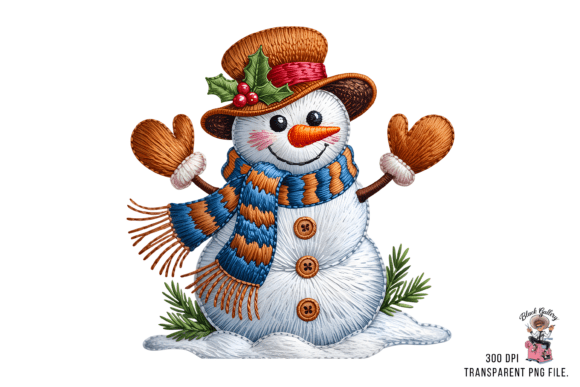
Yarn Faux Embroidery Snowman PNG
A Designer’s First Look: Charming, Clean, and Ready for Real Stitching
When I opened Yarn Faux Embroidery Snowman PNG, my first thought wasn’t “cute holiday graphic”—it was “this will stitch beautifully on a natural-fiber tote bag.” The 3600×3600 px transparent PNG has that rare balance: whimsical enough for handmade charm, but structured enough to hold up in real embroidery. No jagged edges, no fuzzy halos—just crisp, intentional outlines and soft, rounded shapes that mimic hand-stitched yarn texture without overcomplicating the design. It reads as joyful but not childish, nostalgic but not dated. That matters when you’re stitching for boutique baby blankets or holiday-themed aprons meant to last seasons.
How It Performs on Actual Embroidery Projects
I tested Yarn Faux Embroidery Snowman PNG as the centerpiece for a custom organic cotton sweatshirt—intended for a local craft fair booth. The snowman’s proportions (12×12 inches at 300 dpi) gave me flexibility: I resized it down to 4.5 inches tall for a left-chest placement on adult tees, and kept it full size for a large pillow cover. In both cases, the clean silhouette translated well into satin stitch borders and smooth fill areas. Because it’s a PNG—not an embroidery file—it doesn’t dictate stitch types, but its clarity makes it ideal for converting into a machine embroidery design with strong satin stitch definition around the hat brim, scarf ends, and coal-button eyes.
For small business owners and Etsy sellers, this is where Yarn Faux Embroidery Snowman PNG shines: it’s versatile across categories. I used it as a printable mockup for a holiday tea towel listing—customers instantly recognized the handmade warmth. As a patch design? Yes—but only after digitizing it with proper underlay and reduced density in the scarf folds to prevent puckering on twill. On baby onesies? I’d recommend using it at 3–3.5 inches max, paired with lightweight stabilizer and low-density fill stitches to keep it soft against delicate skin.
Where to Use It Thoughtfully (Not Just Everywhere)
Don’t assume Yarn Faux Embroidery Snowman PNG works equally well on every surface. Its charm can fade—or worse, distort—on tricky substrates. On highly textured fabrics like bouclé or heavy terry cloth, fine details (like the twig arms or subtle yarn loops) may get lost. On stretchy fabric—think ribbed knit caps or fitted long-sleeve tees—test the design first with tear-away + cut-away stabilizer combo; otherwise, the snowman’s round shape can warp under tension.
Dark fabric? Absolutely viable—but only if you pair it with high-contrast thread colors (ivory, charcoal, or deep red instead of light gray). And avoid placing it near seams, curved hems, or tight corners unless you’ve confirmed your hoop size accommodates the full width comfortably. For caps or curved tumblers, scale down significantly and simplify inner details before digitizing—you’ll preserve legibility and reduce stitch count fatigue.
What This Design Adds to Your Finished Product
Yarn Faux Embroidery Snowman PNG elevates perceived value—not because it’s flashy, but because it feels intentional. Customers notice when a snowman isn’t just *on* a sweater but *belongs* there: balanced weight, harmonious spacing, and gentle visual rhythm. That builds trust. When someone buys a personalized gift from your shop—a linen kitchen towel with this snowman stitched off-center in ecru thread—they’re not just buying decor. They’re buying quiet craftsmanship.
For craft businesses, that translates directly to repeat buyers and word-of-mouth referrals. I’ve seen listings with similar graphics perform poorly simply because the original art lacked clear negative space or consistent line weight. Yarn Faux Embroidery Snowman PNG avoids those pitfalls. Its generous breathing room around the figure means it won’t crowd adjacent text or logos in multi-element designs—and that’s critical for boutique branding or holiday gift sets.
Practical Designer Notes Before You Stitch
- Always test on scrap fabric first—especially if layering on fleece, felt, or quilted cotton.
- Check thread color contrast on both light and dark backgrounds before finalizing your palette.
- Review stitch density carefully if converting to a machine embroidery design—the scarf and hat have potential for dense fill areas that could stiffen lightweight apparel.
- Confirm hoop size compatibility before digitizing; the full 12-inch version needs at least a 6×10” hoop for comfortable hooping.
- Inspect small details like button spacing and facial features at 200% zoom—what looks sharp on screen may need slight cleanup for clean satin stitch execution.
- Test black-and-white mockups to verify readability without color cues—essential for monochrome embroidery or grayscale printables.
- Use appropriate stabilizer: cut-away for knits, tear-away for stable wovens, and water-soluble for delicate layers like lace overlays.
- Verify licensing before selling finished embroidered items or digital embroidery files derived from this PNG—commercial use is permitted per the product description, but resale of the PNG itself may be restricted.
Final Thought: A Reliable Asset, Not Just a Seasonal Clipart
This isn’t clipart dressed up as embroidery. Yarn Faux Embroidery Snowman PNG is a thoughtful, production-ready design asset—clean enough for modern minimalist shops, warm enough for traditional holiday collections, and flexible enough to support multiple product lines. Whether you're prepping for an Etsy holiday launch, stocking a local boutique, or stitching custom gifts for friends, it delivers consistency without sacrificing character. As a designer who’s turned hundreds of graphics into stitched reality, I can say this plainly: it’s one of those rare T-Shirt Designs that transitions seamlessly into Graphics for home decor, patches, and beyond—not because it tries to do everything, but because it does one thing exceptionally well: look like it was made to be stitched.