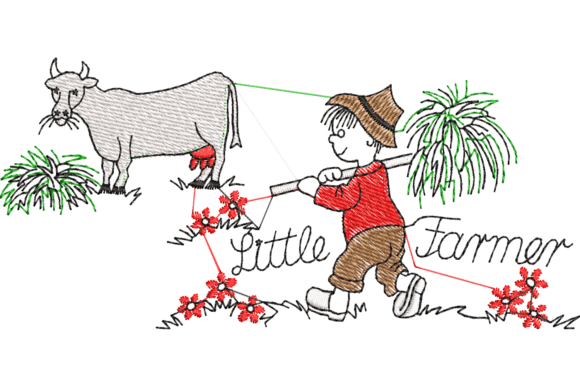
Little Farmer Embroidery Design
A Real-World Stitch Test on a Baby Bib Set
I pulled Little Farmer Embroidery Design off my desktop last week while prepping a small-batch order of organic cotton baby bibs for a local boutique. Not as a quick upload-and-stitch moment—but as a deliberate evaluation: Would this farm-themed character hold up under real stitching conditions? Would it read clearly at 3.5 inches tall on a curved, lightweight fabric? And more importantly—would parents pause mid-unfolding to smile, then snap a photo for Instagram?
First Impressions: Friendly, Not Fussy
The charm of Little Farmer Embroidery Design isn’t in complexity—it’s in balance. The cartoon-style character has soft rounded edges, open facial expression, and just enough detail (a tiny pitchfork, overalls with visible stitching lines) to feel intentional—not generic. It doesn’t shout “farm.” It whispers “backyard harvest” or “first trip to the petting zoo.” That subtlety makes it versatile across age groups and product types—from toddler onesies to kitchen towels for a farmhouse Airbnb.
Visually, it reads well at medium scale (3–4 inches), with clear negative space around the figure. No tight clusters of satin stitch that risk tunneling, no micro-details that vanish when stitched. That’s rare in Farm Animals embroidery files aimed at beginners—and refreshing for seasoned makers who’ve battled stray thread nests from over-engineered designs.
Where It Shines (and Where It Needs Guardrails)
Little Farmer Embroidery Design performs best where warmth and approachability matter most:
- Custom apparel: On midweight cotton sweatshirts or unbleached tote bags, the design anchors without overwhelming. Its horizontal width fits naturally above a pocket or centered on a chest panel.
- Baby embroidery: Stitched on bamboo-cotton blend bibs or swaddle blankets, the friendly face becomes a quiet signature—not too cutesy, not too literal. Parents consistently respond to that gentle tone.
- Embroidered patch: Clean outer edge and moderate stitch density mean it patches cleanly onto denim jackets or overalls without excessive bulk or fraying at the perimeter.
- Holiday embroidery: Paired with a simple “Harvest Blessings” running stitch banner below it, it works beautifully on linen tea towels or pillow covers for fall gifting.
Use With Intention—Not Autopilot
This isn’t a “drop it anywhere” machine embroidery design. A few real-world limits surfaced during testing:
- Small hoop sizes: Below 4" wide, the character’s facial features start compressing. Avoid using it full-size in a 3x3 hoop unless you’re willing to simplify or re-digitize key elements.
- Textured or stretchy fabric: On terry cloth towels or ribbed knit onesies, stabilizer choice is non-negotiable. A tear-away alone won’t cut it—add light cutaway underneath to prevent puckering around the overalls’ fill stitch zones.
- Dark fabric: The design relies on contrast. On navy or charcoal, test thread colors first—ecru or oatmeal thread reads warmer and more authentic than stark white. Avoid pale yellow thread on cream fabric; it disappears.
- Curved surfaces: Caps and beanies require careful placement. The top of the hat brim distorts the character’s head shape if hooped too high. Center it lower—just above the sweatband—for truer proportions.
What It Adds to Your Finished Product
When stitched well, Little Farmer Embroidery Design quietly lifts perceived value. It doesn’t scream “handmade”—it *feels* handmade. That distinction matters for Etsy sellers pricing items at $48+ or boutique owners curating cohesive nursery collections. Customers don’t buy a farm animal; they buy a story anchor—a visual cue that says “thoughtful,” “gentle,” “grounded.”
It also supports brand consistency. If your craft business leans into earthy, unhurried aesthetics—think linen aprons, ceramic mugs, seed packet bundles—this design slots in without jarring contrast. It won’t clash with hand-lettered tags or minimalist packaging. That cohesion builds trust faster than any listing description.
Designer Notes You’ll Actually Use
Before stitching your first client piece or uploading to your digital embroidery file shop:
- Test on scrap fabric—same weight and weave as your final product. Watch how the fill stitch settles on your chosen stabilizer combo.
- Review stitch density in your embroidery software. If it’s above 12,000 stitches, consider simplifying background elements for baby wear or frequent-wash items.
- Confirm hoop size matches your machine’s sweet spot. This design breathes best between 4x4 and 5x7 hoops.
- Inspect small details at 200% zoom: Are the eyes fully stitched? Does the pitchfork handle taper cleanly? One missed node can throw off the whole face.
- Test black-and-white mockups before finalizing listings. Some screen displays mute subtle thread tonal shifts—especially in oatmeal or sage greens.
- Check licensing before selling finished products or bundling the file commercially. Not all Farm Animals embroidery files permit resale of stitched goods without attribution or royalty.
Final Thought: A Design That Serves the Maker
Little Farmer Embroidery Design doesn’t ask for perfection—it invites thoughtful execution. It’s the kind of embroidery file that rewards attention to fabric grain, thread sheen, and placement rhythm. It’s equally at home on a personalized gift for a new aunt or as part of a curated small shop product line. For craft business owners balancing speed and soul, it’s a reminder that sometimes the most effective design decisions are the quietest ones: balanced, legible, and kind to both machine and maker.