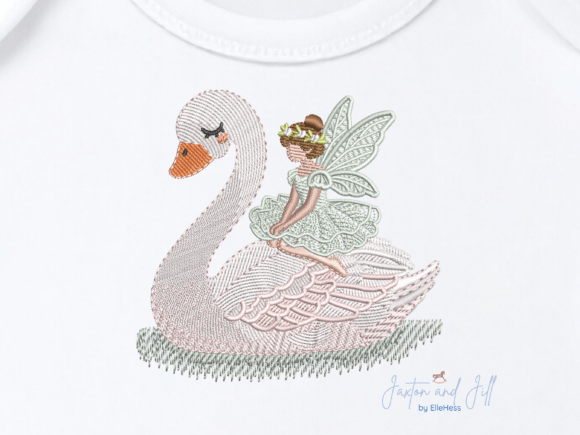
Fairy on Swan Embroidery Design
A Whimsical Yet Professional Touch for Small Business Branding
As an embroidery designer who’s developed and reviewed hundreds of machine embroidery designs for small business merch, my first impression of the Fairy on Swan Embroidery Design is one of balanced charm: it reads as elegant—not cutesy—and intentional—not decorative-only. The phrase “whimsical elegance” in its description lands accurately. This isn’t a cartoonish fairy or a stiff heraldic swan; it’s a softly rendered, harmonious pairing that suggests artistry, care, and quiet confidence. For a boutique florist, a handmade ceramics studio, or a specialty tea shop, this design conveys refinement without formality—ideal for brands that want to feel personal, memorable, and gently distinctive.
Where It Shines in Real Business Applications
The Fairy on Swan Embroidery Design works exceptionally well as an embroidered patch—especially for lapel accents on aprons, tote bags, or staff jackets. Its vertical composition and centered focal point make it highly legible at 2.5–3.5 inches tall, a sweet spot for boutique merchandise and custom apparel. On café aprons or bakery uniforms, it adds warmth and identity without overwhelming function. As cap embroidery, it holds up beautifully on structured front panels—its gentle curves translate well to curved surfaces when digitized with appropriate underlay and pull compensation.
For tote bag design, the Fairy on Swan Embroidery Design serves as both a signature mark and a subtle storytelling device: customers instantly grasp a sense of craft, nature, and lightness. It also performs well on product packaging accents—think stitched labels on linen gift wraps or hand-poured candle boxes—elevating perceived value while reinforcing brand identity across touchpoints. Etsy sellers and handmade product creators will find it especially effective in printable mockups: its clean silhouette and delicate wing detail render crisply in digital previews, helping buyers visualize authenticity and quality before purchase.
Smart Placement Considerations for Long-Term Wear
While versatile, the Fairy on Swan Embroidery Design requires thoughtful execution in certain contexts. Avoid scaling it below 1.75 inches for embroidered patches—it loses wing definition and fairy facial nuance, risking a muddy or indistinct finish. On dark uniforms or textured fabric like canvas or tweed, confirm thread color contrast early: pastel or lightly-tinted wings may need brighter base threads or subtle shadow fills to retain visibility after repeated washing. High stitch density in the swan’s feathers or fairy’s hair could cause stiffness on lightweight fabrics—so always test with proper stabilizer (cutaway for structured items, tear-away for softer garments).
Cap embroidery demands special attention: verify that the curve of the swan’s neck and wing arc align naturally with the cap’s front panel contour. And if you’re using this as part of a larger set of design assets—say, alongside a wordmark or seasonal icon—compare the Fairy on Swan Embroidery Design side-by-side to ensure visual consistency in line weight, spacing, and overall presence.
How It Strengthens Brand Identity and Customer Trust
In small business merch, every stitched element contributes to perception. The Fairy on Swan Embroidery Design signals intentionality: it tells customers your brand values beauty, balance, and craftsmanship—not just utility. That matters. A well-executed fairy motif doesn’t read as childish; it reads as curated. When paired with clean typography and natural materials (linen aprons, organic cotton totes), it reinforces trust in your handmade product ethos. Customers remember how something *feels*—and this design feels considered, calm, and quietly confident.
It also supports visual consistency across channels. Whether stitched on a staff cap, printed on a thank-you card mockup, or featured in an Instagram story highlight, the Fairy on Swan Embroidery Design acts as a unifying visual anchor. That cohesion builds recognition faster than standalone logos alone—especially for creative studios, pet brands with nature-aligned values, or local businesses aiming for neighborhood distinction over mass appeal.
Practical Embroidery Designer Notes Before Production
- Always test in black and white first. This reveals clarity issues in fine details—like wing veining or fairy hair strands—that might disappear in color.
- Check minimum viable size. Run a 2-inch version on scrap fabric to assess whether delicate outlines hold up on your target garment or patch substrate.
- Review thread color pairings carefully. Lightly-tinted wings suggest soft gradients—confirm whether the embroidery file includes satin blends or relies on fill density for dimension.
- Inspect spacing between elements. Ensure the fairy’s feet and swan’s back maintain breathable negative space—critical for avoiding thread buildup and puckering.
- Confirm hoop size compatibility. While not specified in the description, most Birds category embroidery files fall within standard 4x4 or 5x7 hoops—verify before digitizing adjustments.
- Test on real fabric—not just software preview. A swan’s curved body behaves differently on denim vs. twill vs. lightweight chambray.
- Use stabilizer suited to end use. Cutaway for high-wash items (staff uniforms); lightweight tear-away for boutique gift totes.
- Create a client-approved mockup. Especially for commercial embroidery projects, show stitched samples—not just digital renders—to manage expectations around texture and scale.
- Verify commercial licensing. Since this is intended for small business merch and branded patch use, confirm the digital embroidery file permits resale, distribution, and derivative branding before batch production.
Final Thought: More Than a Motif—A Branding Ally
The Fairy on Swan Embroidery Design isn’t just another machine embroidery design—it’s a strategic asset. When applied intentionally, it deepens emotional resonance, elevates perceived quality, and quietly differentiates your small business in crowded markets. Whether you're stitching caps for a florist team, branding tote bags for a local artisan market, or adding embroidered patches to handmade product packaging, this design delivers grace under pressure: delicate enough to charm, structured enough to professionalize. Just remember—the magic isn’t only in the fairy or the swan. It’s in how thoughtfully you bring them to life, stitch by deliberate stitch.