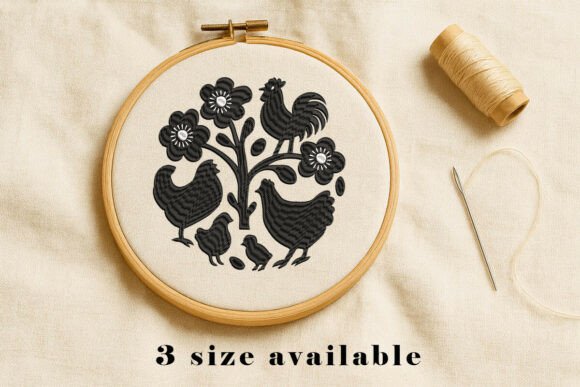
Folk Chicken Floral Embroidery Art
First Impressions: Warm, Whimsical, and Instantly Recognizable
When I opened the Folk Chicken Floral Embroidery Art file, what struck me first wasn’t just the color—it was the personality. This isn’t a stiff, overly symmetrical motif. It’s a folk-art chicken nestled among blossoms and looping vines, with slightly uneven petals, playful stem curves, and a hand-drawn charm that reads as genuinely handmade—not digitally over-polished. The composition balances well: the chicken anchors the center without dominating, while florals extend organically into open space. That breathing room matters. It means you can place it on a tote bag handle, an apron pocket, or a baby onesie chest without crowding the garment’s shape.
A Real Project Test: Stitching It for a Boutique Kitchen Towel Line
Last week, I used Folk Chicken Floral Embroidery Art to develop a small batch of linen tea towels for a local craft shop. We chose medium-weight natural linen—textured, absorbent, and unforgiving of sloppy stitch definition. With proper cutaway stabilizer and 40-weight rayon thread, the design stitched cleanly. The satin-stitched chicken eye popped, the floral centers held detail without piling, and the vine outlines stayed crisp thanks to balanced stitch density—not too sparse (which would look sketchy), not too dense (which would stiffen the fabric unnaturally). Customers responded immediately: “It feels like something my grandmother would’ve stitched,” one said. That warmth? It’s intentional—and it translates.
Where It Shines (and Where It Asks for Care)
Folk Chicken Floral Embroidery Art excels in projects where character and approachability matter more than ultra-fine precision:
- Custom apparel: Works beautifully on cotton tees, fleece-lined hoodies, and relaxed-fit sweatshirts—especially when placed off-center or along a seam line for subtle storytelling.
- Tote bag design: Its horizontal flow fits naturally across the front panel. No awkward cropping needed.
- Baby embroidery: Soft colors and rounded shapes read as gentle and joyful on onesies and burp cloths—but avoid high-density fill areas near seams where stitching could irritate delicate skin.
- Holiday embroidery: Equally at home on Easter egg baskets, Mother’s Day pillow covers, or Christmas kitchen linens. It doesn’t scream “seasonal”—it quietly belongs.
- Embroidered patch: Clean outer edges and moderate detail make it ideal for iron-on or sew-on patches on denim jackets or backpacks.
That said, it’s not universally frictionless. On thin or highly stretchy knits (like lightweight jersey tees), I recommend testing with tear-away + light cutaway stabilizer—some of the finer vine tendrils can blur if the fabric shifts mid-stitch. On dark fabric, double-check your thread color contrast: pale yellows or creams may fade visually unless paired with deeper background tones. And while it’s lovely on curved surfaces like caps, avoid placing it directly over the crown seam—those floral loops need flat real estate to land cleanly.
What It Does for Your Craft Business—Beyond Aesthetics
As an Etsy seller and small shop product developer, I pay close attention to how a machine embroidery design affects perceived value and buyer trust. Folk Chicken Floral Embroidery Art elevates a simple tote bag from “nice” to “thoughtfully made.” Its folk-art authenticity signals care—not just in execution, but in curation. Buyers notice that. They also recognize its versatility: one design, multiple applications (towels, pillows, apparel, patches) means fewer assets to manage and faster mockup turnaround. For printable mockups, it holds up in both light and dark fabric previews because its outline weight and internal contrast are inherently balanced.
Importantly, it supports brand consistency without demanding rigid uniformity. You can pair it with neutral typography for a modern farmhouse line—or layer it beside hand-lettered phrases for a whimsical boutique collection. It doesn’t compete; it complements.
Practical Designer Notes Before You Stitch
- Always test on scrap fabric first—especially if using textured, napped, or loosely woven materials.
- Review stitch density visually before sending to your machine. Look for tight clusters in floral centers that might benefit from slight digitizing tweaks if you have editing access.
- Confirm hoop size compatibility. While not oversized, its spread benefits from at least a 5” x 7” hoop for comfortable placement and tension control.
- Inspect small details at 200% zoom: check whether the chicken’s beak, flower stamens, or vine tips hold clarity at your intended scale.
- Test in black and white mockups to verify readability on varied backgrounds—this reveals contrast issues no color preview catches.
- Use appropriate stabilizer: cutaway for knits and wovens, tear-away for stable linens, and fusible for lightweight cottons where backing must stay invisible.
- Verify licensing terms before selling finished products or bundling the digital embroidery file—commercial use rights aren’t automatic, even for designs marketed for t-shirts and tote bags.
Final Thought: A Design That Feels Like a Conversation Starter
Folk Chicken Floral Embroidery Art doesn’t shout. It invites. Whether stitched onto a nursery pillow, a holiday market apron, or a personalized gift for a new parent, it carries quiet confidence—like a well-worn storybook illustration brought to life in thread. It’s the kind of embroidery file that makes customers pause, smile, and ask, “Who made this?” That’s the mark of strong design: not perfection, but presence. If your craft business values warmth over wow-factor, personality over polish, and thoughtful execution over flash—this is one embroidery file worth keeping within easy reach.